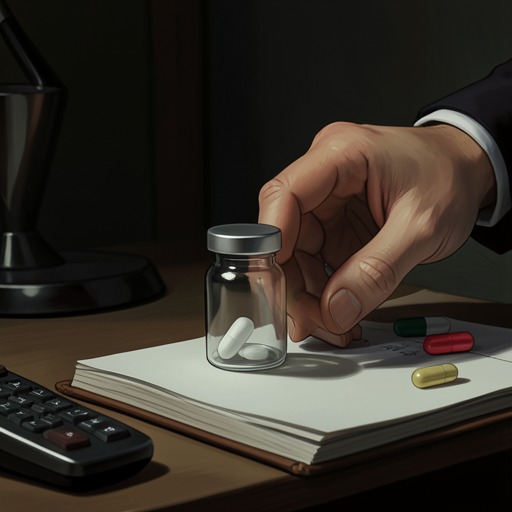
the poisoned aspirin
A Murder Is AnnouncedThe poisoned aspirin is an ordinary medicine transformed into a murder weapon and a crucial clue. After Dora Bunner takes tablets from a bottle beside Letitia Blacklock’s bed, an analysis establishes that they are not aspirin; the suspected narcotic poisoning makes the bottle’s placement, its dwindling contents, and the opportunity to substitute its tablets central to the investigation.
Identity and Discovery
The substance first becomes significant through an absence: when Dermot Craddock later asks whether Mrs Goedler possessed old photographs, the nurse explains that family papers and personal keepsakes were lost when their storage depot was blitzed. That line of inquiry yields nothing, but the search for missing records contrasts with the material clue that emerges in a bottle at Little Paddocks. Here, what matters is not an old document but a familiar medicine whose contents have been changed.
The decisive report comes from Rydesdale. Dora wanted aspirin and took two tablets from a bottle beside Letitia Blacklock’s bed, leaving one behind. The remaining tablet is recovered for analysis, and the doctor says it is definitely not aspirin. The bottle had contained only a few tablets, so the evidence concerns a small, traceable supply rather than an unspecified quantity of medicine.
Dora Bunner’s Death
Dora is found dead in her bed the following morning. The doctor believes she died in her sleep, but does not consider the death natural despite her already poor health. Rydesdale reports narcotic poisoning as the suspected cause, while an autopsy is arranged to investigate further. The evidence therefore distinguishes the initial medical suspicion from a completed forensic conclusion: the tablets are identified as something other than aspirin, and narcotic poisoning is the doctor’s guess pending examination.
The danger lies in the bottle’s everyday setting. Dora is not described as seeking anything other than aspirin; she takes the tablets from beside Letitia’s bed, where a familiar remedy could be mistaken for what its container promised. Her death makes the bottle’s ordinary appearance consequential: its contents have become lethal without ceasing to look like a household medicine.
The Substitution and the Opportunity
Craddock links the tablets to a recent opportunity for substitution. He recalls that Patrick told him Letitia had discarded a half-bottle of sherry and opened a new one. He reasons that she would not necessarily have thought to do the same with an opened aspirin bottle. His point is practical: the bottle could remain in place, apparently harmless, while its contents had been replaced.
The tablets cannot have been there long, Craddock concludes. Asked who had been in the house during the preceding day or two, Rydesdale identifies everyone present at the birthday party for Miss Bunner the previous day. Any of them could have gone upstairs and made a neat substitution; alternatively, anyone living in the house could have done so at some earlier time. The party supplies a recent shared opportunity, but the bottle’s location also leaves open the possibility of access by a resident. The clue narrows the period without, at this stage, naming the person responsible.
The Bottle as a Last Clue
The aspirin bottle returns in the curious list that Bunch reads: after “Lamp” and “Violets,” it asks, “Where is bottle of aspirin?” The question gives the object a second role. It is not only the source of the tablets Dora takes, but also something sought or recalled in a written sequence associated with the investigation. The list’s progression from concrete household objects to a question about the bottle keeps the clue active rather than resolved.
Together, the death report and the list make the aspirin bottle an unusually compact piece of evidence: its location links it to Letitia’s bedside, Dora’s choice explains how its altered contents are taken, the remaining tablet permits analysis, and the recent party frames a possible window for substitution. The bottle’s familiarity is precisely what makes it deceptive. Its label and use belong to routine domestic life; once the contents prove false, that routine becomes the means by which danger passes unnoticed.